GL.iNet Beryl 7 (MT3600BE) review
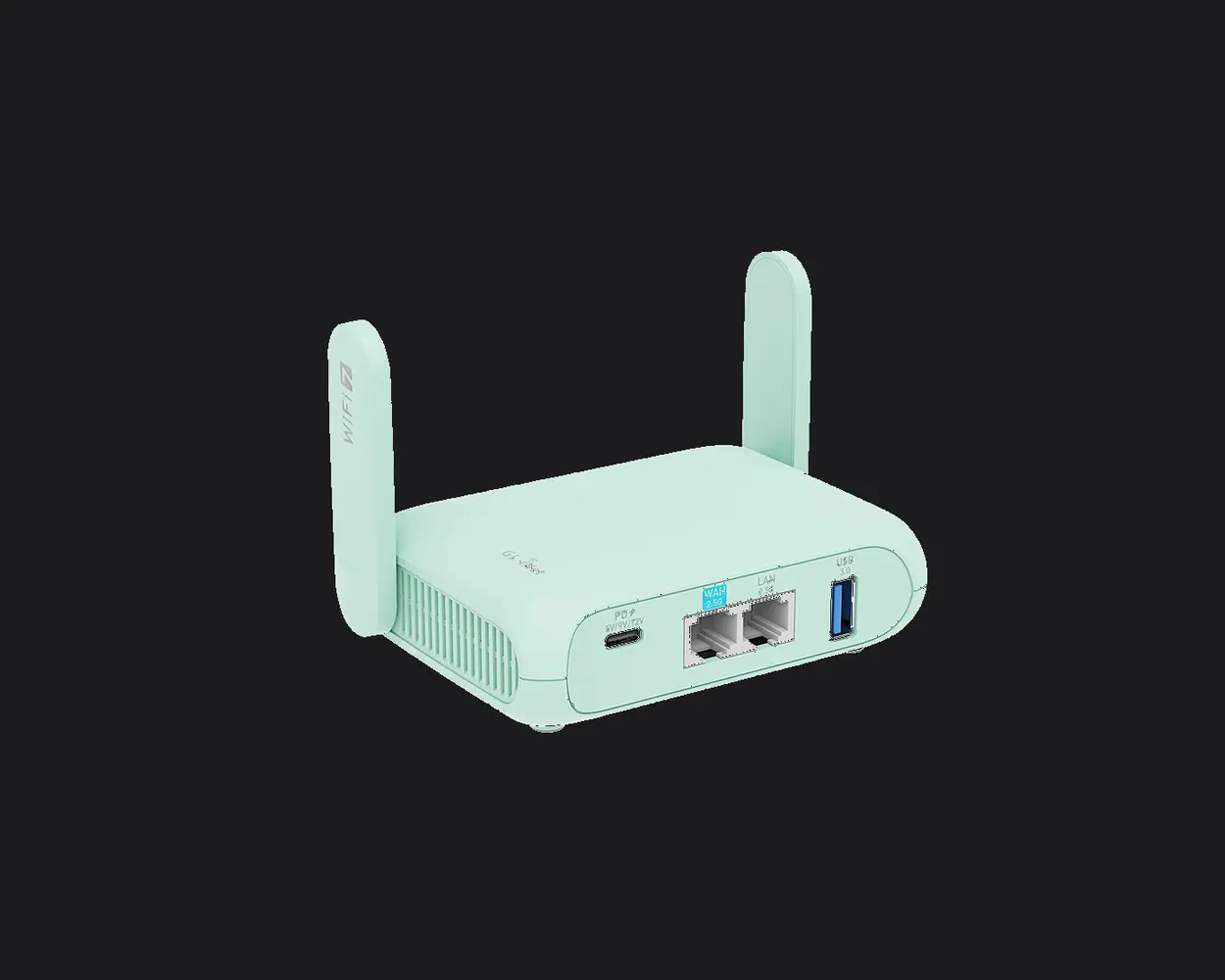
The GL.iNet Beryl 7 is the Wi-Fi 7 successor to the Beryl AX: a compact travel router with two 2.5G ports and WireGuard rated up to 1,100 Mbps, without the Slate 7's touchscreen.
GL.iNet Beryl 7 (MT3600BE) review
The GL.iNet Beryl 7 is the Wi-Fi 7 successor to the Beryl AX: a compact travel router with two 2.5G ports and WireGuard rated up to 1,100 Mbps, without the Slate 7’s touchscreen.
Who is this for? Travellers and home users who want to upgrade from the Beryl AX to Wi-Fi 7 and significantly higher VPN throughput, without paying the Slate 7 premium for a touchscreen they don’t need.
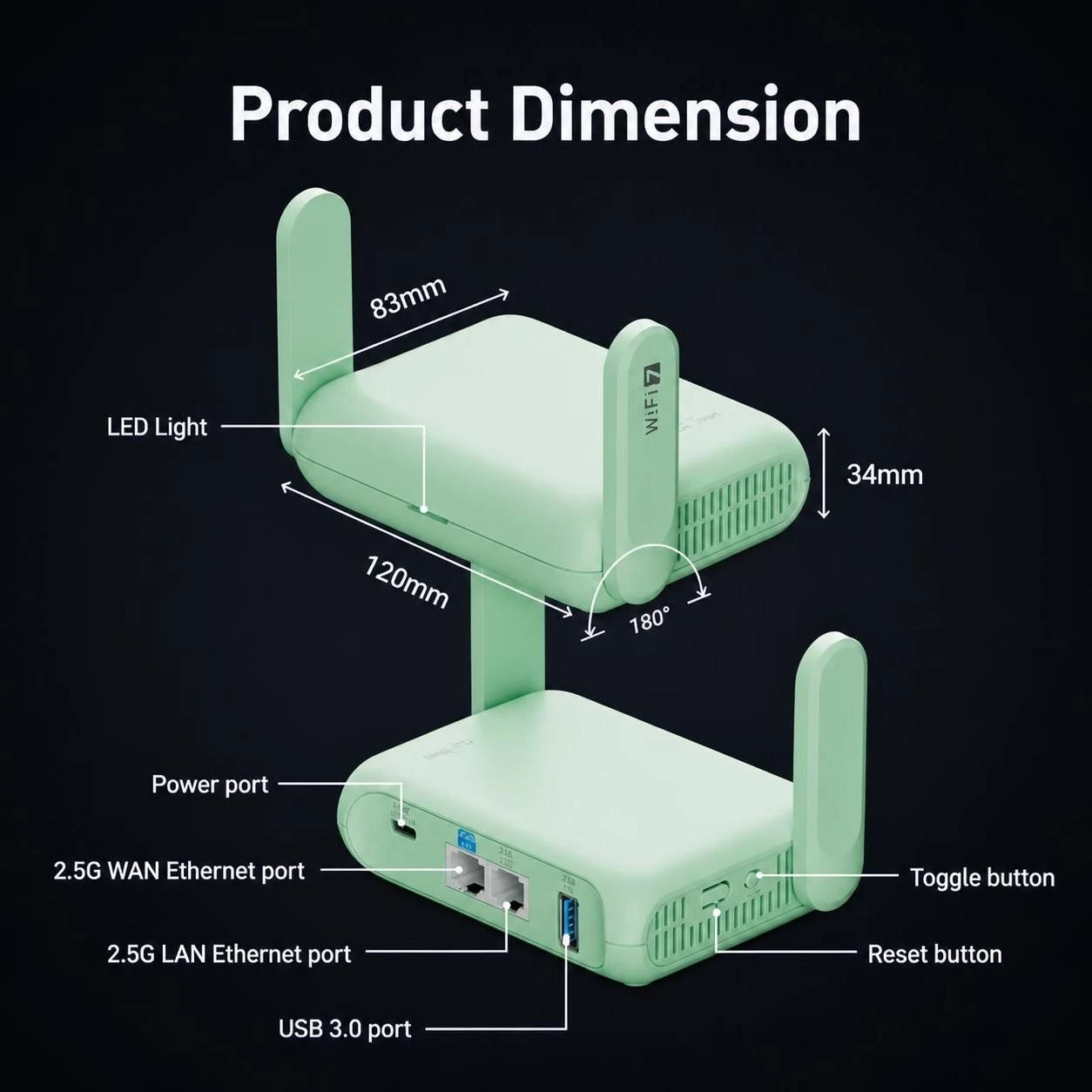
The Beryl 7 is the direct successor to the Beryl AX: faster processor, Wi-Fi 7, both Ethernet ports at 2.5G, and a WireGuard rating of up to 1,100 Mbps, nearly four times its predecessor’s. The dimensions are the same and it is 9 g heavier. The price sits below the Slate 7, and there is no touchscreen.
Specifications
| Property | Value |
|---|---|
| Processor | MediaTek quad-core @2.0 GHz |
| RAM | 512 MB DDR4 |
| Storage | 512 MB NAND |
| Wi-Fi | Wi-Fi 7 dual-band (BE3600): 688 Mbps (2.4 GHz) + 2,882 Mbps (5 GHz) |
| Ethernet | 2× 2.5G (both configurable as WAN or LAN; default 1× WAN, 1× LAN) |
| Operating system | GL.iNet firmware 4.9 based on OpenWrt 21.02; official OpenWrt also available |
| USB | 1× USB 3.0 |
| Power | USB-C, PD (5V/3A, 9V/3A, 12V/2.5A) |
| Dimensions | 120 × 83 × 34 mm, 205 g |
| Price | around €136 / $130 (check current price) |
WireGuard performance
GL.iNet specifies WireGuard throughput up to 1,100 Mbps for the Beryl 7 — nearly four times the Beryl AX (up to 300 Mbps) and more than double the Slate 7 (~490 Mbps). The pricier Slate 7 Pro has the same figure.
GL.iNet tests these figures on a local network, over Ethernet, in client mode. Its own FAQ calls 30–50% of the advertised maximum normal under typical network conditions, so expect less through a real VPN provider.
On a slow hotel connection you will rarely notice the difference: the connection limits you before the router does. For home use on a 500 Mbps+ fibre connection, or for office use where you don’t want the router to be the bottleneck, the extra headroom matters.
OpenVPN-DCO reaches up to 1,000 Mbps — level with the Slate 7 Pro and higher than the other GL.iNet travel routers in the current lineup.
Beryl 7 vs Beryl AX
| Beryl AX (MT3000) | Beryl 7 (MT3600BE) | |
|---|---|---|
| Wi-Fi | Wi-Fi 6 (AX3000) | Wi-Fi 7 (BE3600) |
| CPU | Dual-core 1.3 GHz | Quad-core 2.0 GHz |
| RAM | 512 MB | 512 MB |
| Storage | 256 MB NAND | 512 MB NAND |
| Ethernet WAN | 1× 2.5G | 1× 2.5G |
| Ethernet LAN | 1× Gigabit | 1× 2.5G |
| WireGuard | up to 300 Mbps | ~1,100 Mbps |
| Touchscreen | No | No |
| Power | USB-C (5V/3A) | USB-C PD (up to 12V/2.5A) |
The upgrade is real where it counts: faster CPU, Wi-Fi 7, a higher VPN rating, twice the storage, a 2.5G LAN port, and a LAN port that can become a second WAN, which the Beryl AX doesn’t support. RAM stays at 512 MB.
Beryl 7 vs Slate 7
| Slate 7 (BE3600) | Beryl 7 (MT3600BE) | |
|---|---|---|
| Wi-Fi | Wi-Fi 7 BE3600 | Wi-Fi 7 BE3600 |
| WireGuard | ~490 Mbps | ~1,100 Mbps |
| Ethernet | 2× 2.5G (configurable) | 2× 2.5G (configurable) |
| Touchscreen | Yes | No |
| RAM | 1 GB | 512 MB |
| Price | higher | lower |
The Beryl 7 delivers higher VPN throughput than the Slate 7 at a lower price, but has less RAM and no touchscreen. Both routers have two configurable 2.5G ports (a second Ethernet WAN is possible on both); the Slate 7 additionally has a touchscreen for instant VPN status without opening a browser.
Beryl 7 vs Slate 7 Pro
| Beryl 7 (MT3600BE) | Slate 7 Pro (BE10000) | |
|---|---|---|
| Wi-Fi | Dual-band Wi-Fi 7 (2.4 + 5 GHz) | Tri-band Wi-Fi 7 (+ 6 GHz) |
| CPU | MediaTek quad-core 2.0 GHz | MediaTek quad-core 2.0 GHz |
| RAM | 512 MB | 1 GB |
| WireGuard | ~1,100 Mbps | ~1,100 Mbps |
| OpenVPN-DCO | ~1,000 Mbps | ~1,000 Mbps |
| Ethernet | 2× 2.5G configurable | 2× 2.5G configurable |
| Touchscreen | No | Yes (2.8”) |
| Weight | 205 g | 328 g |
| Price | around €136 / $130 | around €253 / $240* |
*The Slate 7 Pro is not currently sold in the US — see the Slate 7 Pro review.
VPN speed is the same: same CPU class, same WireGuard and OpenVPN-DCO figures from GL.iNet. For roughly €115 more in the EU (it isn’t sold in the US), the Slate 7 Pro adds three things: the 6 GHz band, a touchscreen and twice the RAM. None of them makes your connection more secure or more private.
Choose the Beryl 7 if you mainly want a VPN tunnel on hotel, train or home networks. That’s most travellers, and the lighter Beryl 7 does exactly the same job for roughly half the price.
Choose the Slate 7 Pro if your laptop and phone have a 6 GHz radio (Wi-Fi 6E or Wi-Fi 7) and you’ll also use the router as a fast main router at home or in the office, or if you want VPN status on a screen without opening a browser. More in the Slate 7 Pro review.
OpenWrt and web interface
The Beryl 7 runs GL.iNet’s 4.x firmware, like the rest of the series, but models don’t get each version at the same time: its current stable version is 4.9.0 (July 2026). Via the web interface you can configure:
- WireGuard and OpenVPN client (built-in WireGuard providers, others via a configuration file)
- DNS-over-TLS and DNS-over-HTTPS for devices that use the router’s DNS
- AdGuard Home as built-in DNS ad blocker (off by default)
- Login Mode for Public Hotspots, for hotel Wi-Fi login pages
- Repeater mode: connect to hotel Wi-Fi, share a secure connection with all your devices
- Per-device VPN policy and kill switch
- Multi-WAN failover
Those who want to can use the command line over SSH. Official OpenWrt (25.12.6) also supports this model and replaces GL.iNet’s firmware, but its device page says wireless performance and stability on this hardware still need work.
Use cases
Travelling: Connect the Beryl 7 to hotel Wi-Fi or an Ethernet port, set up WireGuard for all clients, and every device on the router goes through the VPN. Configure once, not per device. A hotel sees the router as one device, so you do its login page once.
As a small home router: Wi-Fi 7 and the highest WireGuard rating in GL.iNet’s travel line suit a flat or small household on a fast connection. Only the Beryl 7 and the much pricier Slate 7 Pro are rated above gigabit among GL.iNet’s travel routers; through a real VPN provider, expect less.
Office and remote work: For encrypted tunnels from a hotel or co-working space back to your office or home server.
Caveats
One LAN port by default: For several wired devices you need a switch, or you set the WAN port to LAN and get internet over Wi-Fi or tethering. Failover between Ethernet and Wi-Fi or tethering needs no port change. Two Ethernet WANs do: you set the LAN port to WAN, which leaves no wired LAN port.
No touchscreen: The Slate 7 shows VPN status and speed directly on the display without opening a browser. On the Beryl 7 you open the admin panel for that.
512 MB RAM: GL.iNet offers AdGuard Home and OpenWrt plug-ins on this model; we didn’t measure memory use. Less than the Slate 7 (1 GB) for those wanting to run multiple heavy services simultaneously.
VPN speed on hotel networks: the higher rating only helps on a connection faster than a Beryl AX can handle. On a slow hotel connection, a Beryl AX does as well.
Hotel login pages: in Login Mode for Public Hotspots, GL.iNet says some services are suspended and DNS switches to automatic, which may leak your network activity to the hotspot provider. The mode ends after a successful login. If the login page doesn’t appear, its troubleshooting has you switch off VPN connections and AdGuard Home, so check that the VPN is back on afterwards.
Older OpenWrt base: firmware 4.9 builds on OpenWrt 21.02, which OpenWrt itself lists as End of Life since May 2023. GL.iNet says it patches security holes in older versions and publishes security advisories; we didn’t check which fixes it carries over, so keep the firmware up to date.
Pros and cons
Pros
- WireGuard rated up to 1,100 Mbps — the highest rating in GL.iNet’s travel router lineup, level with the pricier Slate 7 Pro
- Wi-Fi 7 with Multi-Link Operation, which GL.iNet says gives more bandwidth and more reliable connections (needs a Wi-Fi 7 device)
- Both Ethernet ports at 2.5G and configurable as WAN or LAN — dual-WAN failover possible
- USB-C PD power — works with chargers and power banks that offer 5V/3A, 9V/3A or 12V/2.5A
- AdGuard Home, hotel login mode, kill switch, and DNS encryption built in
- Lower price than the Slate 7
Cons
- No touchscreen for instant VPN status (that is the Slate 7)
- One LAN port by default: several wired devices need a switch, or the WAN port set to LAN
- Firmware on OpenWrt 21.02, End of Life upstream
- 512 MB RAM — less than the Slate 7 (1 GB)
- WireGuard advantage over the Beryl AX is only felt on fast connections
Conclusion
The Beryl 7 is the logical replacement for the Beryl AX if you are buying a new travel router today. Wi-Fi 7, a faster processor, 2.5G on both ports, and a WireGuard rating of up to 1,100 Mbps make it the better router, though the RAM stays the same. The price sits below the Slate 7, and if you don’t need a touchscreen, the Beryl 7 gives you a higher VPN rating at a lower cost.
Choose the Slate 7 if you want VPN status visible without opening a browser; multi-WAN failover is on both routers, so it doesn’t decide this. Choose the Flint 2 or Flint 3 if you want a fixed home router with multiple LAN ports.
Next step
Chosen the Beryl 7?
- GL.iNet travel router setup guide — step-by-step WireGuard, DNS-over-TLS and AdGuard Home configuration
Similar options
- GL.iNet Beryl AX review — the previous generation, worth considering second-hand
- GL.iNet Slate 7 review — the Wi-Fi 7 travel router with touchscreen
- GL.iNet Slate 7 Pro review — same VPN speed, plus 6 GHz and a touchscreen, for almost twice the price
Want to go further?
- Can you trust your router? — how to evaluate brand trust yourself
- Which network fits your profile? — how much router do you actually need?