GL.iNet Flint 4 (BE14000) review
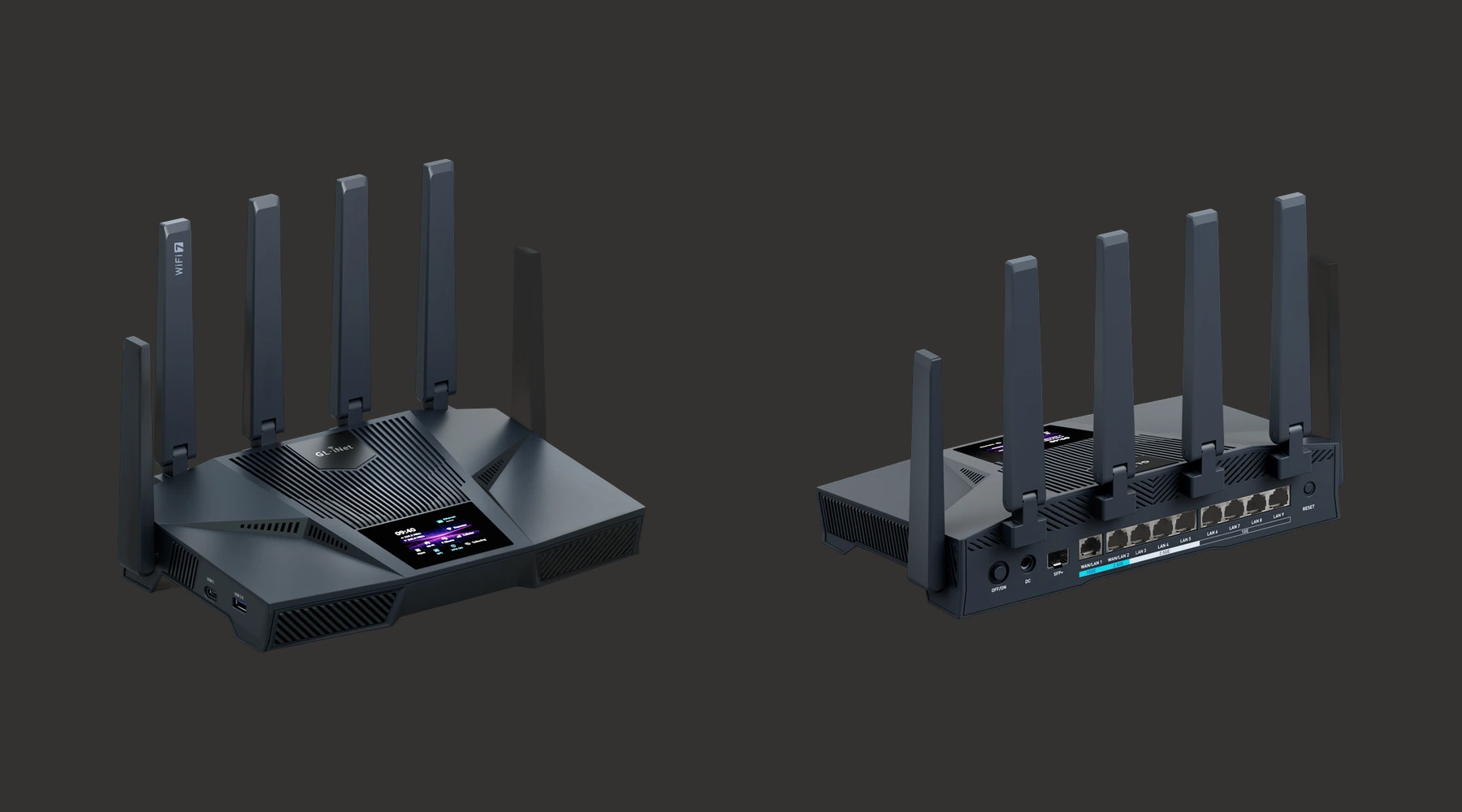
The Flint 4 is GL.iNet's fastest home router: tri-band Wi-Fi 7, a 10G SFP+ port, a 10G Ethernet port and WireGuard up to 1.5 Gbps. Its stable firmware is still built on OpenWrt 21.02, a branch that stopped getting updates in 2023; a 4.11 test firmware moves to OpenWrt 25.12.
GL.iNet Flint 4 (BE14000) review
The Flint 4 is GL.iNet’s fastest home router: tri-band Wi-Fi 7, a 10G SFP+ port, a 10G Ethernet port and WireGuard up to 1.5 Gbps. Its stable firmware is still built on OpenWrt 21.02, a branch that stopped getting updates in 2023; a 4.11 test firmware moves to OpenWrt 25.12.
Who is this for? Home and small-office users who will really use 10G ports or a VPN connection above 1 Gbps on wired devices. For most homes the Flint 3 does the same job for about €176 less.
How we checked: PrivacyGear has not tested a Flint 4 in our own network. This review is based on GL.iNet’s product pages, firmware data and release notes, the firmware images themselves (stable 4.9.2 and test build 4.11.0, downloaded from GL.iNet with matching checksums and unpacked), OpenWrt’s source tree and download server, and dated reports from owners on GL.iNet’s and OpenWrt’s forums, all checked on 5 November 2026. Owner reports are marked as such.
Specifications
| Property | Value |
|---|---|
| Wi-Fi | Wi-Fi 7 tri-band (BE14000) with MLO |
| Wi-Fi speeds | 688 Mbps (2.4 GHz) + 4,323 Mbps (5 GHz) + 8,646 Mbps (6 GHz) |
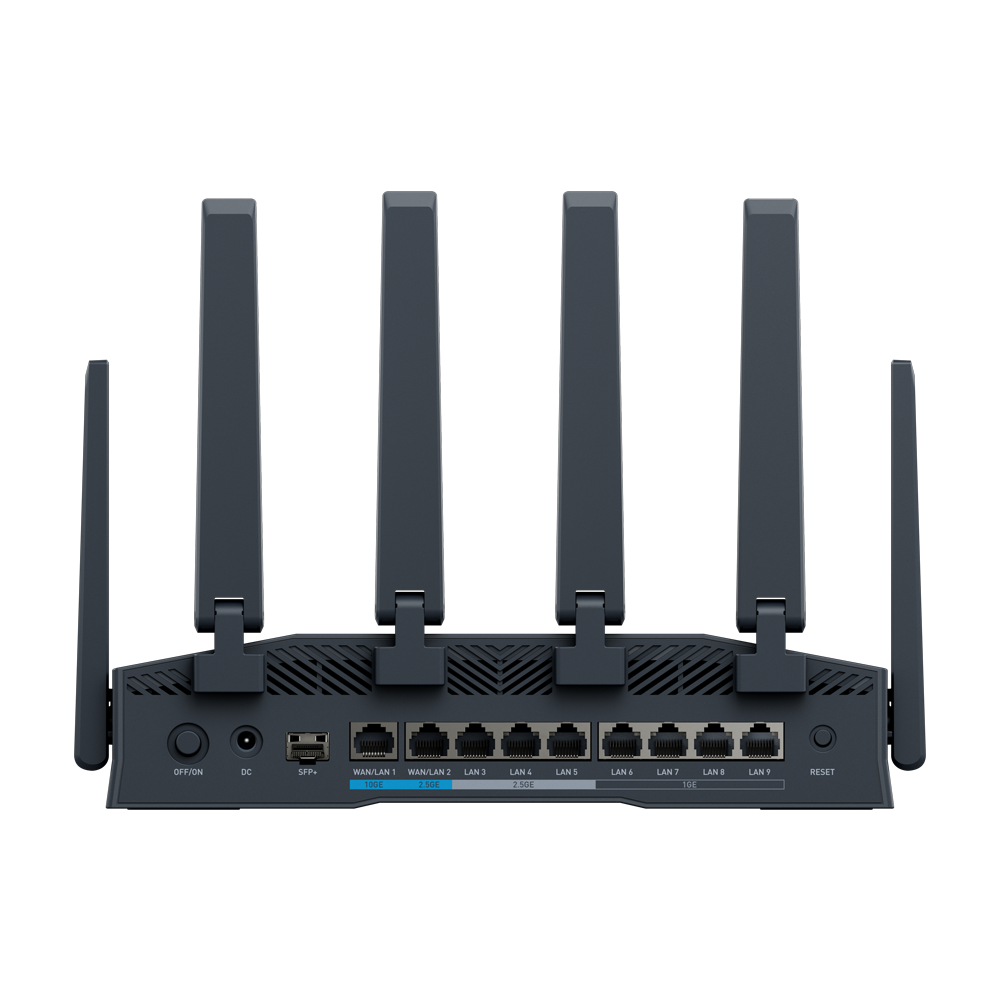
| Ethernet | 1x 10G SFP+ WAN/LAN, 1x 10GbE WAN/LAN, 1x 2.5GbE WAN/LAN, 3x 2.5GbE LAN, 4x 1GbE LAN |
| WireGuard | up to 1.5 Gbps (GL.iNet, client mode) |
| OpenVPN-DCO | up to 1.5 Gbps (GL.iNet, client mode) |
| Processor | MediaTek MT7988 (quad-core Cortex-A73, 1.8 GHz) |
| RAM / storage | 2 GB DDR4 / 64 GB eMMC |
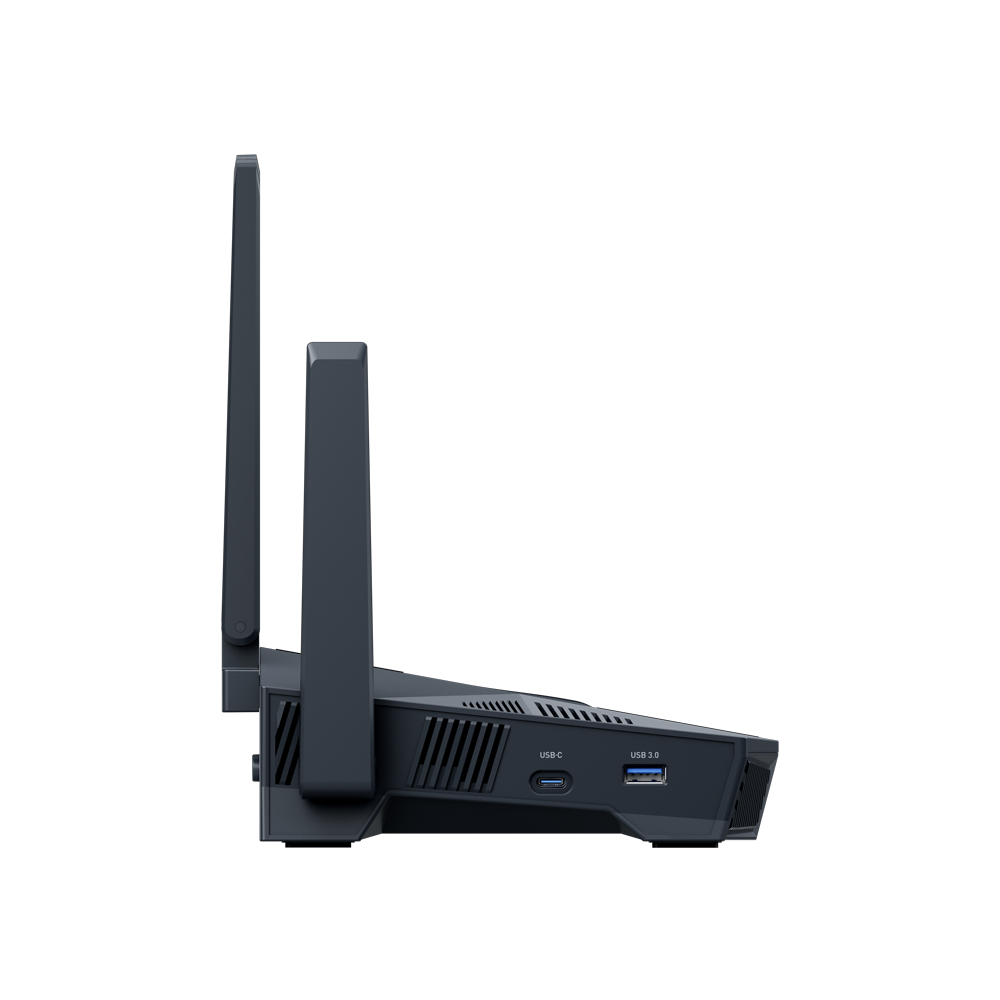
| USB | 1x USB-C 3.0, 1x USB-A 3.0 |
| Extras | 2.4-inch touchscreen, 6 foldable external antennas |
| Firmware | Stable: GL.iNet 4.9.2 (28 September 2026), built on OpenWrt 21.02-SNAPSHOT, Linux 5.4. Testing: 4.11.0 beta (29 October 2026), OpenWrt 25.12-SNAPSHOT, Linux 6.12 |
| Price | €389.43 incl. VAT (GL.iNet EU store, German warehouse, in stock); $369.99 in GL.iNet’s US store, where it is not available |
Prices from GL.iNet’s own EU and US stores on 5 November 2026; resellers and Amazon can be cheaper or dearer. GL.iNet’s US page says the Flint 4 is “currently unavailable in the U.S. due to recent FCC-related developments”; its statement says FCC certification has not been granted yet.
What is new compared to the Flint 3?
| Flint 3 (BE9300) | Flint 4 (BE14000) | |
|---|---|---|
| Chipset | Qualcomm | MediaTek MT7988 |
| Wi-Fi | Wi-Fi 7 BE9300 | Wi-Fi 7 BE14000 |
| 10G ports | None | 1x SFP+ WAN/LAN + 1x 10GbE WAN/LAN |
| 2.5G ports | 5x | 1x WAN/LAN + 3x LAN |
| 1G ports | None | 4x |
| WireGuard (GL.iNet’s figure) | ~680 Mbps | up to 1.5 Gbps |
| Touchscreen | No | Yes |
| OpenWrt base of the stable firmware | 23.05 | 21.02 (25.12 in testing) |
| Price (GL.iNet store) | €213.52 / $209.99 | €389.43 / $369.99 (not sold in the US) |
The 10G ports and the wired VPN speed are the real upgrades. If your internet connection is 1 Gbps or slower and you have no 10G devices, the Flint 4 adds little you will notice, and its stable firmware is built on an older OpenWrt base than the Flint 3’s (GL.iNet’s firmware table lists 23.05 for the Flint 3).
The firmware underneath: OpenWrt 21.02 and Linux 5.4
For a privacy router, the software matters more than the port count. We unpacked GL.iNet’s stable firmware 4.9.2 for the Flint 4: it identifies itself as OpenWrt 21.02-SNAPSHOT and runs Linux kernel 5.4.281. Kernel 5.4 is no longer on kernel.org’s list of maintained long-term kernels (kernel.org). The Wi-Fi runs on MediaTek’s own closed driver (mt_wifi), not on the open mt76 driver that regular OpenWrt uses.
Older OpenWrt base: the firmware builds on OpenWrt 21.02, which OpenWrt itself lists as End of Life since May 2023. GL.iNet maintains its own firmware and publishes security advisories; we didn’t check which fixes it carries over, so keep the firmware up to date.
Newer base in testing: GL.iNet’s release notes for the 4.11.0 test firmware say it updates OpenWrt to 25.12. In beta 6 (29 October 2026) we read OpenWrt 25.12-SNAPSHOT and Linux 6.12.94, still with mt_wifi. It is not a stable release yet, and owners are reporting bugs in the betas.
This is not unique to the Flint 4. GL.iNet says some models run “an older OpenWrt version due to restrictions with the SDK provided by our chipset manufacturer”, and that it patches “any security vulnerabilities found in these older OpenWrt version” before release (GL.iNet firmware versions). Its table (last updated 21 September 2026) lists the Flint 2, also on MediaTek’s SDK, at 21.02 too; the Flint 4 was not in it when we last read that tab, on 19 October.
What this means in practice: on stable firmware you depend on GL.iNet to backport fixes into an old base, instead of getting them from the OpenWrt project directly. Keep the admin panel off the internet too (don’t open it on the WAN side; use the VPN server if you need remote access).
Vanilla OpenWrt: development snapshots only
With the Flint 2, you can replace GL.iNet’s firmware with regular OpenWrt from a stable release (it is in OpenWrt 25.12.6). The Flint 4 is partway there: OpenWrt added it to its main branch on 3 November 2026, and its snapshot builds now include Flint 4 images, using OpenWrt’s own MT7996 Wi-Fi packages instead of mt_wifi. It is not in stable 25.12.6.
Snapshots are development builds, installed through the router’s U-Boot recovery page. The OpenWrt developer says the touchscreen work is still being finished, and testers on OpenWrt’s forum reported slow Wi-Fi start-up and an SFP+ module problem in the first days (owner reports, 4 November). Unofficial community builds on GitHub, from September 2026, came before this. All of it is a reasonable experiment for people who know how to recover a router, not a setup we would recommend to most readers.
GL.iNet also publishes a “clean” OpenWrt image for the Flint 4 (4.9.1, 16 September 2026). We read it: the same OpenWrt 21.02-SNAPSHOT and Linux 5.4.281, so it doesn’t get you off the old base. Until a stable OpenWrt release includes the Flint 4, most buyers will be running GL.iNet’s firmware.
See Can you trust a router brand? for why vanilla OpenWrt matters, and what it does and doesn’t fix.
VPN speed: fast wired, slower over Wi-Fi
GL.iNet’s figure of up to 1.5 Gbps for WireGuard and OpenVPN-DCO is measured in client mode, and GL.iNet itself says speeds are lower when the router is the VPN server.
Over Wi-Fi it is lower still. Owners reported in September 2026 that VPN speed from Wi-Fi devices is roughly half of what wired devices get. One example from GL.iNet’s forum (13 September, owner’s test): 880 Mbps through ProtonVPN on a wired PC, 510/410 Mbps through the same VPN on a phone over Wi-Fi that reached 860/930 Mbps without it. GL.iNet’s staff replied on 14 September that “the maximum VPN throughput from a Wi-Fi client can be lower than the throughput measured from an Ethernet client” because the router also has to handle the Wi-Fi traffic, and that “optimizations will be considered”. No fix had been announced by 5 November, and the 4.11.0 release notes don’t list one.
If you buy the Flint 4 for the VPN speed, the 1.5 Gbps applies to wired devices. Over Wi-Fi, plan on numbers closer to what cheaper GL.iNet routers reach.
Firmware maturity
The Flint 4 has had two stable firmware releases: 4.9.1 (8 August 2026) and 4.9.2 (28 September 2026), the second adding SFP+ DAC support and fixing Wi-Fi compatibility with some IoT devices and Ethernet-port issues (release notes). GL.iNet’s firmware data lists 4.11.0 as testing (latest build 29 October 2026); there is no stable 4.11 for the Flint 4 yet.
Open issues reported by owners in September and October 2026 (owner reports, not confirmed by GL.iNet unless stated):
- Upload over Wi-Fi capped with hardware acceleration on: at least two owners see Wi-Fi upload drop sharply with network acceleration enabled (one, on a 4.11 beta: about 2,200 down / 250-300 up with it on, 674/661 with it off). GL.iNet could not reproduce it in its lab as of 15 October and is collecting configurations.
- Mesh and MLO: bug reports, mostly on the 4.11 betas (a mesh node switching its 5 GHz band off and on, MLO working in router mode but not in access-point mode).
This is normal for a router a few months after launch, and both releases so far fixed real problems. If you need everything to work on day one, the Flint 3 has been on sale since mid-2025.
Built-in features
From GL.iNet’s product page, on the stock firmware:
- WireGuard and OpenVPN client and server. GL.iNet advertises 30+ VPN services; the 4.9.2 firmware has nine WireGuard providers built in, and others work with a configuration file
- AdGuard Home for network-wide ad and tracker blocking
- VLAN segmentation (see network segmentation at home)
- A 4G/5G USB dongle or phone as backup internet (multi-WAN)
- Network storage over Samba, WebDAV or DLNA from a USB drive
- A touchscreen for VPN on/off and status
Encrypted DNS and per-device VPN rules work the way they do on other GL.iNet routers; the GL.iNet setup guide walks through them.
Flint 3 or Flint 4?
Choose the Flint 4 if you have a connection faster than 1 Gbps, a NAS or switch with 10G or SFP+, or want more than ~700 Mbps through WireGuard on wired devices.
Choose the Flint 3 if your connection is 1 Gbps or slower, you mostly use Wi-Fi, or you want a newer OpenWrt base on stable firmware (23.05) and a longer track record, for about €176 less (in the US the Flint 4 isn’t sold at all).
Neither is in a stable OpenWrt release today: the Flint 4 only has development snapshots, and we found no OpenWrt support for the Flint 3. The Flint 2 is the GL.iNet home router in OpenWrt’s stable release, at Wi-Fi 6 speeds.
Pros and cons
Pros
- 10G SFP+ and 10GbE ports, plus 2.5G and 1G ports for everything else
- WireGuard and OpenVPN-DCO up to 1.5 Gbps on wired devices (GL.iNet’s figure)
- 2 GB RAM and 64 GB storage: room for AdGuard Home, logs and add-ons
- In stock in the EU from GL.iNet’s German warehouse
Cons
- Stable firmware built on OpenWrt 21.02 (end of life since 2023) and Linux 5.4; security depends on GL.iNet’s backports. OpenWrt 25.12 is in testing
- No stable OpenWrt release yet; only development snapshots (since 3 November) and community builds
- VPN speed over Wi-Fi about half of wired (owner tests; GL.iNet acknowledged, no fix yet)
- About €176 more than the Flint 3; not sold in the US
Getting started
- Update to the latest stable firmware first (4.9.2 at the time of writing) under System → Upgrade; the release notes on GL.iNet’s download page list what each version fixes.
- Set up WireGuard, encrypted DNS, AdGuard Home and a guest network as in our GL.iNet setup guide. It gives the path per firmware; on 4.9.2, DNS is under Network → DNS.
- If Wi-Fi upload speeds look wrong, compare with Network → Network Acceleration switched off (the setting owners in those reports turn off); that is the issue owners report above.
- Leave remote admin access off (Security → Admin Access, HTTPS Remote Access and SSH Remote Access under Remote Access Control); use the router’s VPN server if you need to reach your network from outside.
Replacing a router you already set up? Write down its VPN, DNS and Wi-Fi settings and set the Flint 4 up fresh with them, rather than restoring a backup from a different model.
Conclusion
The Flint 4 is the fastest router GL.iNet sells, and for a home with 10G gear or a multi-gigabit fiber line it is a real step up. For a privacy router, two things hold it back today: the stable firmware sits on OpenWrt 21.02 and Linux 5.4, and OpenWrt support is only in development snapshots. Both are moving, with GL.iNet’s 25.12 firmware in testing and OpenWrt’s support just added. Its VPN speed over Wi-Fi is also well below the headline figure. If you don’t need the 10G ports, the Flint 3 is the better buy; if a stable OpenWrt release matters most to you, the Flint 2 still is.
We will update this review when a stable OpenWrt release adds the Flint 4, when GL.iNet’s 4.11 goes stable, or when it fixes the Wi-Fi VPN speed.
Next step
Want to know which router fits your needs?
- Which network fits your profile? — how much router do you actually need?
Alternatives
- GL.iNet Flint 3 review — Wi-Fi 7 home router, newer OpenWrt base, about €176 cheaper
- GL.iNet Flint 2 review — Wi-Fi 6, in OpenWrt’s stable release
- GL.iNet Brume 3 review — maximum VPN speed without Wi-Fi