Faraday bag guide — when to use it, which product for which situation
Who this guide is for: People with keyless-entry car keys, journalists and lawyers handling sensitive physical meetings, and anyone who wants to shield RFID cards. For most readers, this is further than they need to go.
Faraday bag guide
Who this guide is for: People with keyless-entry car keys, journalists and lawyers handling sensitive physical meetings, and anyone who wants to shield RFID cards. For most readers, this is further than they need to go.
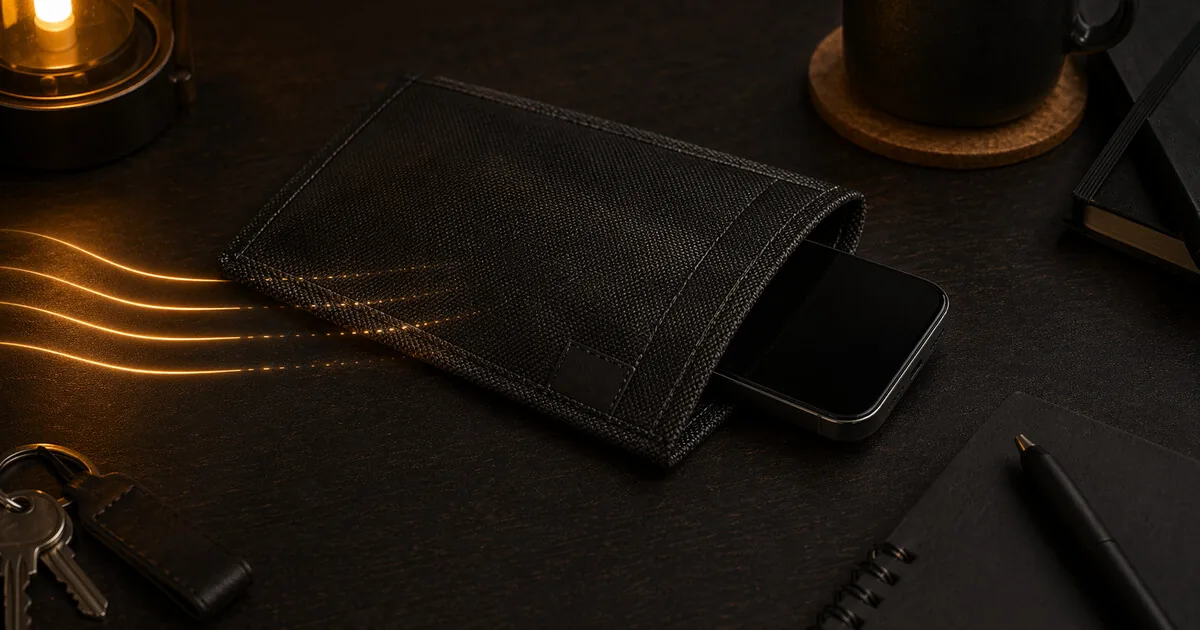
A Faraday bag blocks all wireless signals from a device inside it: no WiFi, no Bluetooth, no mobile network (4G/5G), no GPS. The device is completely isolated from the outside world.
This is useful in specific situations — but it solves no problem if the device itself is already compromised.
What you gain, and what it costs
You gain physical radio silence. A device inside a good Faraday bag cannot make network contact, cannot broadcast a keyless-entry signal, and cannot reveal its location through live radios. That makes it useful for a small number of very concrete threats.
The cost is inconvenience and limited scope. Your device also becomes temporarily unusable for communication or navigation, and a Faraday bag does nothing against malware, forensic access after the device comes out again, or bad operational decisions.
When this is overkill
For everyday privacy problems, you usually get more value from a properly locked phone, regular updates, and better app choices. A Faraday bag mainly makes sense for relay attacks on car keys, sensitive in-person meetings, or situations where you really need to cut off every radio signal for a while.
How a Faraday bag works
A Faraday cage is a metallic enclosure that keeps electromagnetic fields out. The principle was described by Michael Faraday in 1836. Modern Faraday bags use a layer of conductive material (copper mesh, silver fibre, or aluminium foil) woven into the fabric.
What is blocked:
- GSM / 4G / 5G (mobile network)
- WiFi (2.4 GHz and 5 GHz)
- Bluetooth
- NFC
- GPS (reception — GPS doesn’t transmit, but a device cannot determine its position)
- RFID (for key cases: access cards, car keys)
What is NOT blocked:
- Malware already on the device (that runs locally, without a network)
- A powered-on device waiting for connection — as soon as you take it out of the bag, it immediately connects
When a Faraday bag makes sense
Sensitive physical meetings
For a conversation that must not be listened to via the phone: phone in the Faraday bag. No live connection to external servers, no mobile or Wi-Fi location updates, and no direct remote control as long as the device is actually isolated.
When this is relevant: journalist with source, lawyer with client, business negotiation, sensitive personal situation.
Border crossings
At border crossings in certain countries, authorities can request your phone for inspection. A phone that has been in a Faraday bag for several days at least shows no network location history for that period — though local storage history is still present.
Car keys (relay attack prevention)
Modern car keys with passive keyless entry communicate wirelessly with the car when the system thinks the key is nearby. Criminals use relay equipment and two people to forward that exchange between the key and the car — the car “thinks” the key is present and unlocks.
A Faraday key case blocks this. Cheap, simple, effective.
Newer cars are less vulnerable. Vehicles from roughly 2023 onward increasingly use ultra-wideband (UWB) digital keys (the Car Connectivity Consortium’s Digital Key 3.0, also how phone-as-key works on some BMW, Genesis, and other models). UWB measures the actual distance to the key by timing the signal, so a relayed signal that takes longer is rejected — relay attacks largely do not work against it. If your car still uses a plain passive keyless fob, the Faraday case matters; if it uses UWB, it is belt-and-braces rather than essential.
Passports and RFID cards
Biometric passports and some access or payment cards use RFID or NFC. A good shielding sleeve or wallet can make unwanted short-range reads harder or impossible.
Storing devices you don’t want tracked
An old phone, a spare device, a GPS tracker you want to neutralise — in a Faraday bag it is invisible to networks.
When a Faraday bag does NOT help
If the device is already compromised: Spyware stores data locally and transmits it once the device reconnects. The bag only delays the transmission.
If alternative tracking is active: Your location can also be determined via:
- Other devices you carry (smartwatch, laptop, wireless earbuds)
- Camera footage and facial recognition
- Payment transactions (debit cards, public transport)
- Other people with phones nearby
If the bag doesn’t close properly or is damaged: A small opening in the material can be enough to let signals through. Our test shows how to verify this.
For daily use: Keeping a phone continuously in a Faraday bag means you receive no calls, messages, or notifications. Not practical if you need to be reachable.
Which product for which situation
Faraday key case — car keys
For keyless entry car keys. Small, inexpensive (usually well under $20 / €20), fits on a key ring. Purpose: prevent relay attacks. Only works if the key fits completely inside and the closure is sealed.
Test: Put the key in the case, walk to your car and try to open the door. If it doesn’t open: the case works.
Faraday phone pouch — phone in sensitive situations
Larger than a key case, fits around a modern smartphone including its case. For situations where you want to completely isolate your phone temporarily.
Use: Phone switched off or in flight mode + in the pouch. Double certainty: flight mode disables software signals, and the pouch blocks anything the software might miss.
See also the Faraday bag signal test — measured results from both products.
How to test effectiveness
A Faraday bag is only reliable if you have tested that it works:
Test 1 — mobile connectivity:
- Put your phone in the bag (switched on, not in flight mode)
- Try to call it — you should hear “unavailable” or voicemail
- After taking the phone out, send yourself a message or open a site over mobile data. If nothing came in while it was stored, that is an extra sign the shielding worked
Test 2 — WiFi:
- Phone in bag
- Check on another device whether the phone is still visible in your WiFi network — it should not be
Test 3 — car key: Walk to your car with the key in the case. The door should not open.
If any of these tests fail: the bag is damaged or not closing properly.
Frequently asked questions
Does the phone need to be switched off? Not necessarily — the bag should block signals regardless of the device’s state. But switched off or in flight mode gives extra certainty and also reduces the chance that an already compromised phone keeps recording locally or doing other actions while stored in the bag.
Can I make my own Faraday bag? Aluminium foil works to a limited extent, but never seals as well as a quality bag with an overlapping closure. For serious protection: use a tested product.
Does a Faraday bag also protect against EMP? Not designed for that. An EMP has much higher energy levels than wireless signals. For EMP protection you need thicker metal shielding.
Conclusion
A Faraday bag is a simple and effective tool for specific situations: relay attacks on car keys, isolation during sensitive conversations, RFID protection. It is not an everyday privacy tool but an instrument for specific threats.
Buy it if you recognise one of the use cases above — not as a general “privacy solution”. Always test whether it works before relying on it.
Next step
Reviews
- Faraday bag signal test — which bags actually block signals instead of relying on marketing claims
Profiles
- Profile: journalist and activist — when Faraday makes sense
- Profile: high risk — complete approach for high threat level
Go further
- Security as a habit — Faraday in context of your overall security behaviour