Zodl review — the leading Zcash wallet, with a past
Who this is for: For readers following the Zcash guide who want a mobile wallet. Zodl is the wallet built and recommended by the people who built Zcash itself — the most obvious choice, not the only one.
Zodl review
Who this is for: For readers following the Zcash guide who want a mobile wallet. Zodl is the wallet built and recommended by the people who built Zcash itself — the most obvious choice, not the only one.
Zodl was called “Zashi” until early 2026. Same app, same code, same team — only the name changed, after an organizational split explained later in this review. If you’re searching for “Zashi,” this is the same wallet.
First, what you should know before you start
Two things belong up front, not buried at the bottom in a caveat section.
The Orchard bug (May–June 2026). Since May 2022, the cryptographic code behind Orchard — the component of Zcash that makes shielded transactions possible — contained a flaw: a check that was supposed to guarantee no fake ZEC could be created didn’t work as intended. Security researcher Taylor Hornby — at the time working as a paid consultant engaged by Shielded Labs specifically to hunt for this kind of bug — discovered this on May 29, 2026 (using an AI-assisted audit tool); the network temporarily disabled shielded transactions within days, and an emergency update (NU6.2) fixed the issue on June 3, 2026. There’s no confirmed evidence the bug was ever exploited, but Shielded Labs — the team behind Zcash’s privacy technology — has itself said this can’t be ruled out with certainty either, precisely because shielded transactions are deliberately untraceable by design. ZEC’s price fell 30–50% when this news broke. As a longer-term fix, the NU6.3 “Ironwood” upgrade (28 July 2026) moved all future shielded activity into a newly separated pool and closed the entire Orchard pool (~3.66M ZEC, ~$1.7bn at the time) to new deposits; Ironwood ships with a machine-checked proof (2,700+ theorems) that it cannot create undetectable counterfeit ZEC.
The rename and the split behind it. In January 2026, the entire engineering team at Electric Coin Co. (ECC, the organization behind Zashi/Zcash) left the project after a disagreement with Bootstrap, ECC’s governing foundation. At issue: the team wanted to restructure the wallet into an externally funded, more company-like structure; Bootstrap saw legal problems with that given its nonprofit status. The team formed a new organization, Zcash Open Development Lab (ZODL), raised $25 million in funding in March 2026 (Paradigm, a16z, Winklevoss Capital, Coinbase Ventures), and took wallet development with them. The name changed from “Zashi” to “Zodl” via a normal in-app update starting February 26, 2026 — same app, same source code, no user action required, the same seed phrases keep working.
Neither point means the current wallet is unsafe or unreliable — the code is technically sound since the patch, and the project hasn’t disappeared, just reorganized. But an honest review starts here.
Shielded by default, and what that actually means
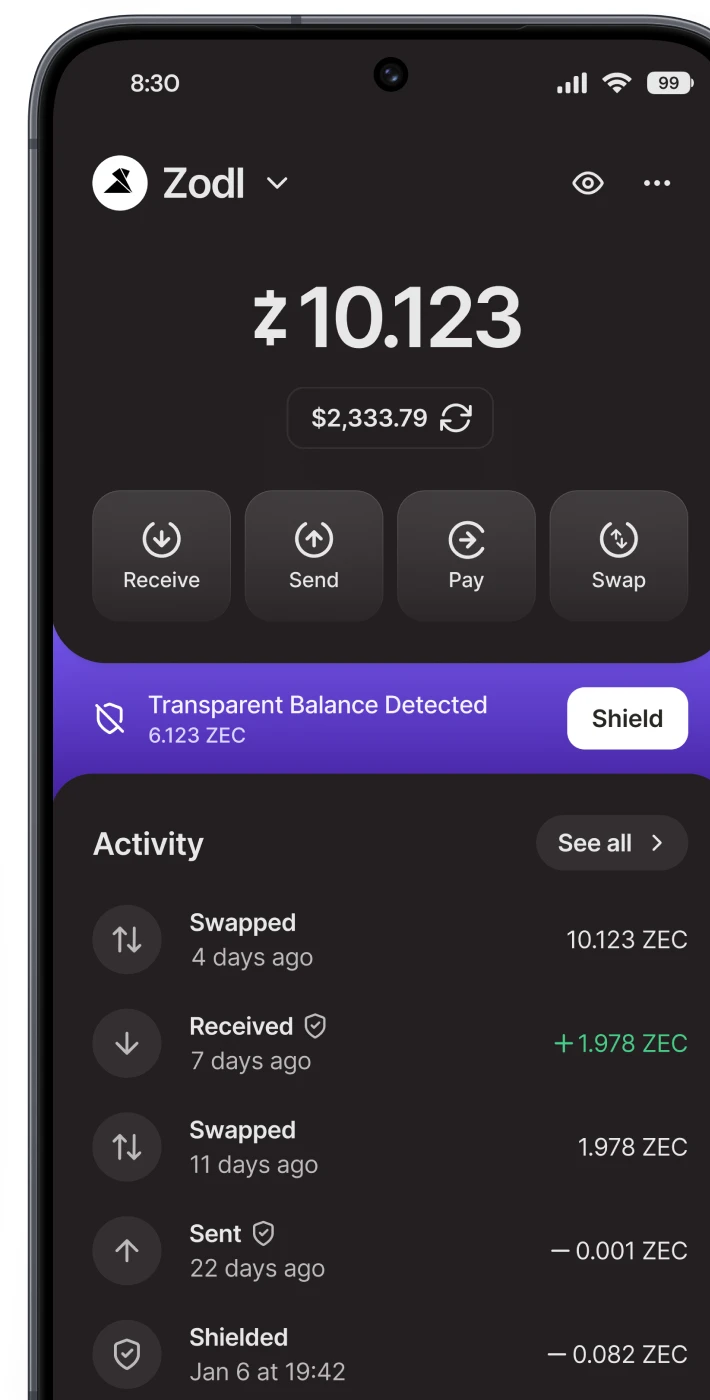
Since May 2025 (version 2.0.3, still under the Zashi name), Zodl shows only a shielded receive address by default — a rotating Unified Address that uses only the private Orchard layer. Before that, the default address also included a transparent receiver, originally meant for exchange compatibility. Electric Coin Co. removed it themselves, stating that no exchange had ever actually made use of it, while it represented a real privacy risk.
A separate transparent address remains available if you need one (for example, to receive from an exchange that doesn’t support shielded addresses), but that now requires a deliberate extra step — it’s no longer the default behavior.
This has had a measurable effect on the network as a whole. The share of shielded transactions on Zcash rose to a peak of 59.3% in February 2026, directly attributable to this change in the most widely used wallet. See the Zcash guide for the full explanation of what this does and doesn’t solve.
Swapping and spending inside the app
Zodl has built-in swap functionality (“Zodl Swaps,” built on NEAR Intents infrastructure) that lets you convert BTC, SOL, USDC, and other currencies directly into ZEC — and shield it immediately.
Caveat, with a concrete incident that has since been fixed. In October 2025, blockchain investigator ZachXBT found that this swap feature sent an unshielded refund back to the user’s original transparent address after a shield-and-swap action — a visible link between shielded and transparent activity that undermined the very privacy the user was trying to achieve. ECC acknowledged the issue. Per the project’s own changelog, this was fixed in Android version 3.4.0 (May 12, 2026): “Corrected issue where a shielded address could be reused as a swap refund address.”
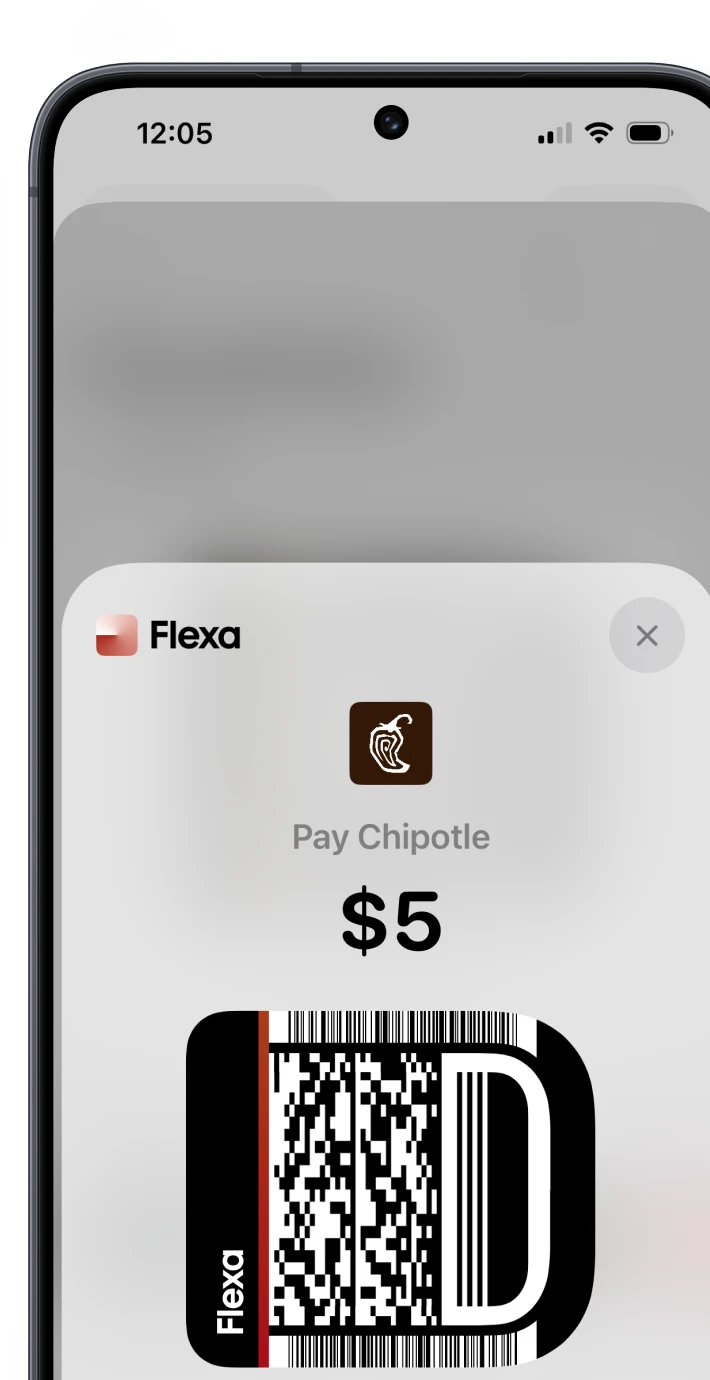
Through a partnership with Flexa, you can also spend shielded ZEC directly at a network of physical stores (mostly US, Canada, El Salvador) without the merchant seeing your identity or even that Zcash was used — for Dutch/European readers this is mainly relevant while travelling, not for everyday use at home.
Hardware wallets and future multisig
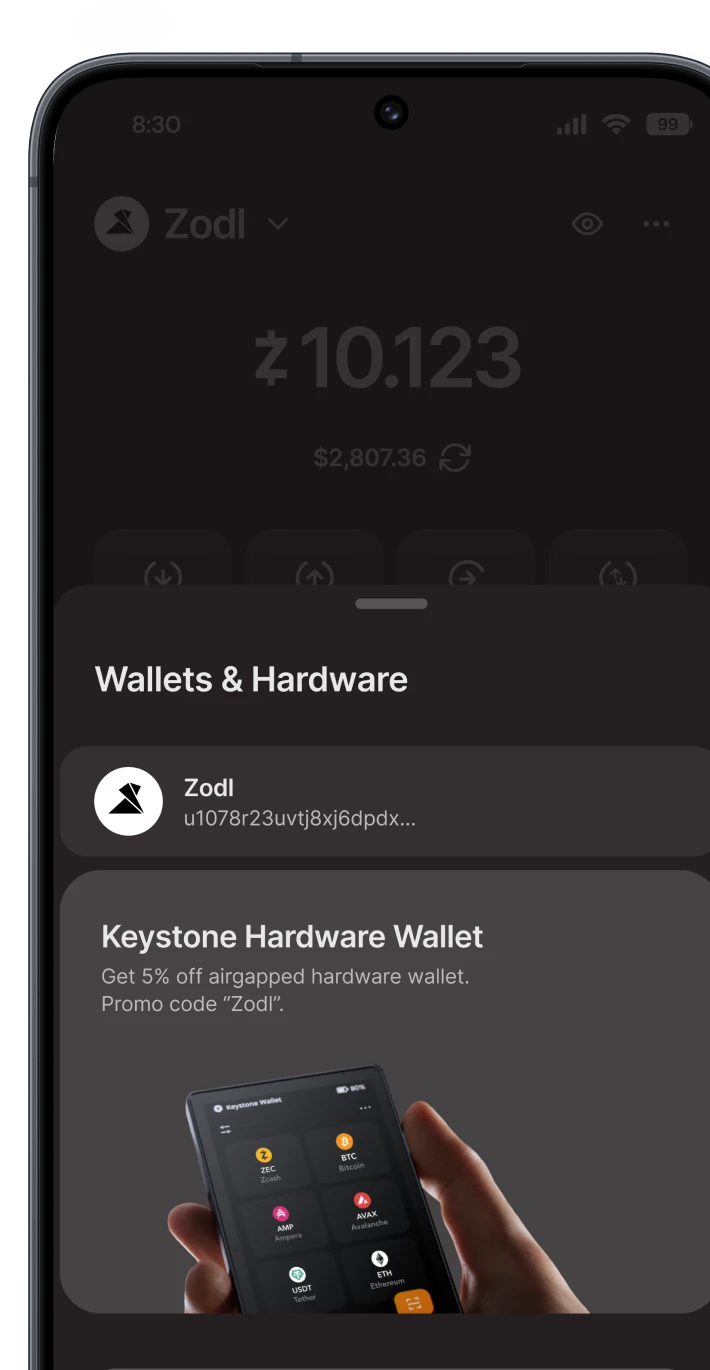
Keystone is currently the only hardware wallet that supports shielded ZEC transactions, via a QR-code-based signing flow (similar in spirit to Cake Wallet’s air-gapped Cupcake model, though it’s a dedicated hardware device rather than a second phone). Multisig via Keystone is on the roadmap, currently aimed mainly at securing the Zcash development fund rather than regular users yet.
Not confirmed: whether Zodl supports view-only wallets — no clear documentation was found either way, and this isn’t claimed as a feature in this review until directly verified.
Security practices
There’s no published independent audit of the Zodl app itself. What does exist deserves precise explanation, since it’s easy to conflate:
- QEDIT conducted a formal audit of the underlying Orchard/Halo2 cryptography (the protocol, not the wallet app) in 2021 — explicitly including the exact circuit where the 2026 bug later turned up. That audit reported no critical issues at the time. This isn’t a reason for extra confidence; if anything, it’s a warning that a formal audit can miss a real problem.
- Least Authority audited the Keystone hardware wallet’s Zcash/PCZT integration — again, the hardware integration, not the Zodl app itself.
- No published, ongoing bug bounty program was found (no HackerOne or Immunefi listing). Responsible disclosure runs informally through named contacts. The 2026 Orchard bug was found by a paid security consultant Shielded Labs had specifically engaged for this kind of research, not through a public bounty program.
Actively maintained: yes, strongly — thousands of commits and dozens of releases, with a steady release cadence continuing through 2026. Despite the organizational split, development hasn’t slowed.
Comparison with Cake Wallet (which also supports Zcash)
| Zodl | Cake Wallet | |
|---|---|---|
| Coins | Zcash only | Zcash, Monero, Bitcoin, Litecoin, etc. |
| Shielded by default | Yes, since May 2025 | Yes, also on by default (“autoshielding”) |
| Platform | iOS, Android | Android, iOS, macOS, Linux |
| Built-in swap | Yes (NEAR Intents) | Yes |
| Hardware wallet support | Keystone (shielded ZEC) | Trezor, Ledger, BitBox (transparent ZEC only) |
| Open-source | Yes (MIT) | Yes (MIT) |
| Independent audit | Not known (protocol audits exist) | One multisig review (2021) |
Zodl is the more specialized choice for readers who specifically use Zcash and want shielded-by-default behavior without having to choose it themselves. Cake Wallet is more relevant if you already want to manage multiple coins in one app and Zcash is one of them — see the Cake Wallet review for the full comparison against Monero wallets.
Getting started
Download: zodl.com (electriccoin.co/zashi redirects automatically), Google Play, Apple App Store, or F-Droid (co.electriccoin.zcash.foss).
Creating a wallet:
- Open Zodl and choose to create a new wallet
- Write down the 24-word recovery phrase immediately and store it separate from your phone
- The default receive address is already shielded — no extra setting needed
- If you still need a transparent address (for example, for an exchange that doesn’t support shielded addresses), look for it deliberately in the address options
Watch out with exchanges: some exchanges restrict withdrawals to a shielded address in certain regions. Check with your exchange first.
Caveats
The Orchard bug is a real trust incident, not just a historical footnote. See the explanation at the top of this review. There’s no confirmed misuse, but it also can’t be ruled out with certainty — that’s a structural feature of how privacy-by-design works, not a minor caveat.
No independent audit of the app itself. The protocol audits that do exist (QEDIT, Least Authority) cover different layers than the Zodl app, and the QEDIT audit missed the later Orchard bug in exactly the area it was checking.
Organizational uncertainty. The split between ECC and the team behind ZODL is recent (January–March 2026). The project is moving forward and development is active, but this isn’t a stable, long-established organizational structure the way Monero’s community model is.
The swap-refund issue (October 2025) is fixed, but that it happened at all is still worth knowing. See the section above — the fix is confirmed in the version 3.4.0 changelog (May 2026), but the incident shows that newer features like cross-chain swaps can introduce a privacy leak that only gets caught after the fact.
Mobile only. No official desktop wallet. Readers who want to work on desktop need to look at a different Zcash wallet or node software instead.
Pros and cons
Pros
- Open-source (MIT), built by the team behind Zcash itself
- Shielded addresses by default since May 2025 — no manual setting needed
- Built-in swap and Flexa payment integration
- Keystone hardware wallet support for shielded ZEC
- Actively and visibly maintained, even after the organizational split
Cons
- Serious recent bug in the shielded-pool cryptography (May–June 2026), exploitation can’t be ruled out with certainty
- No independent audit of the app itself
- Organizational split in early 2026 — younger, less proven governance than Monero wallets
- Mobile only, no desktop version
Conclusion
Zodl is the obvious choice for anyone who wants to use Zcash on mobile: shielded by default, actively maintained, built by the team that designed the protocol itself. It’s not a wallet to recommend carelessly — the 2026 Orchard bug and the organizational split are both recent and both real, and both belong stated before you start, not tucked away as a caveat.
For readers who specifically want to use Zcash and want shielded-by-default without hassle, Zodl is a reasonable, but not carefree, choice. Readers who’d rather have privacy with no exceptions, without these specific caveats, should look at the Monero guide and its wallets instead.
Next step
Coming from the Zcash guide?
- Zcash guide — how Zcash’s privacy works, what it doesn’t solve, and the EU regulation on the way
Similar options
- Cake Wallet — multi-coin, also supports Zcash alongside Monero and Bitcoin
Want to go further?
- Monero guide — privacy-by-default with no exceptions
- Choosing a password manager — store your recovery phrase here, not loose on your phone