RFID-blocking wallet review
RFID-blocking wallets prevent contactless bank cards from being read remotely. Useful accessory or unnecessary hype?
RFID-blocking wallet review
Contactless bank cards, transit cards, and ID cards communicate via RFID (Radio Frequency Identification) or NFC. A reader at close range can read these cards — in principle without you noticing.
RFID-blocking wallets and card holders contain a foil that blocks radio waves in the relevant frequency range.
Is the risk real?
The theoretical risk: Someone with a wireless reader could in principle read your contactless bank card when within ~10 cm. Modern EMV contactless payment cards have limited protection against this: a payment usually requires action from the cardholder (for higher amounts), but card numbers and expiry dates are readable.
The practical risk: In practice, documented cases of “RFID theft” are rare. Banks monitor for unusual transactions. The risk exists but is not significant.
Transit cards and ID cards: Transit cards store travel data that can be read. Passports with RFID chips (biometric) contain name, photo, and date of birth — but are protected with Basic Access Control (BAC) meaning the chip is only readable when the passport is open.
Conclusion: An RFID wallet is a sensible, inexpensive precaution, but not a critical security need for most people.
How RFID blocking works
RFID-blocking wallets contain a layer of metal foil (aluminium or carbon fibre) that acts as a Faraday cage. Radio waves at 13.56 MHz (NFC/contactless payments) and 125 kHz (older RFID) are blocked.
What is blocked:
- Contactless bank cards (13.56 MHz)
- Transit cards
- RFID access badges
- Biometric passports (partially)
What is not blocked:
- Mobile phone (Bluetooth, WiFi, 4G)
- Actively initiated mobile payments (Apple Pay, Google Pay require deliberate action)
Specifications
| Property | Value |
|---|---|
| Blocked frequencies | 13.56 MHz (NFC), 125 kHz (RFID) |
| Material | Aluminium foil inlay, leather or nylon exterior |
| Card capacity | 4–12 cards (depending on model) |
| Price | €10–40 |
| Certification | No standard, manufacturer tested |
What to look for when buying
Verify the blocking: Good wallets are tested. Put your transit card in the wallet and try to scan it at a gate — it should be rejected. Do the same with your bank card at a contactless payment terminal.
Capacity: Choose based on the number of cards you carry. A slim card holder (3–4 cards) is sufficient for most people.
Material: Aluminium inlay is effective and cheap. Carbon fibre variants are more expensive but not necessarily better. Leather or nylon exterior is a matter of preference.
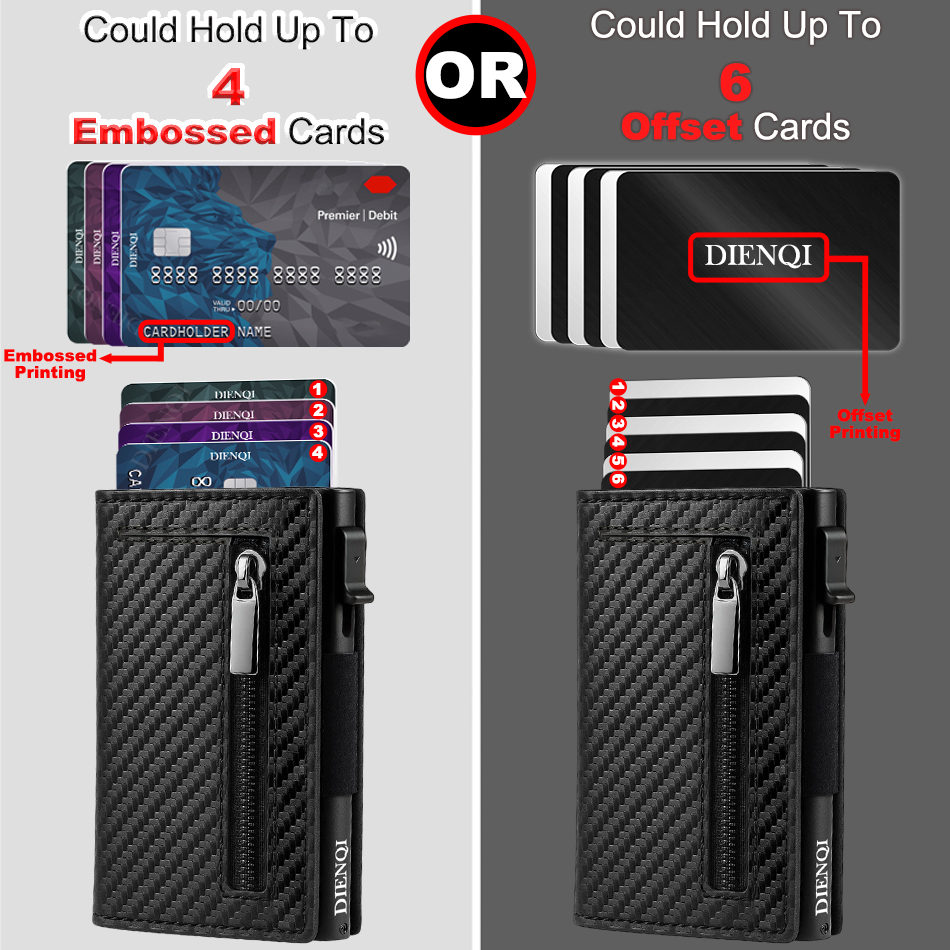
Slide design: Some wallets have a slide mechanism that pushes cards up for easy access. Convenient, but check whether this compromises the blocking.
Alternatives
Aluminium card holder: A simple aluminium card holder (€5–10) does the same as an expensive RFID wallet. The foil is the working part.
RFID protection sleeve per card: Individual foil card sleeves (€1–3 each) protect one card per sleeve. More flexible if you don’t want to block all cards.
DIY: A piece of kitchen foil wrapped around your bank card works. Not practical for daily use, but the principle is identical.
Conclusion
An RFID-blocking wallet is a sensible, affordable precaution. The risk of contactless card theft is not large, but the protection costs little. For anyone carrying contactless transit cards and bank cards in one place: it’s worth the small investment.
Choose a wallet you’ll actually use — a cheap aluminium card holder you always carry is better than an expensive leather wallet that stays at home.
See also:
- USB data blocker review — protection on a different front
- Privacy apps overview — complete overview