GL.iNet Flint 3 (BE9300) review
The GL.iNet Flint 3 is a Wi-Fi 7 home router with five 2.5G ports, tri-band Wi-Fi and built-in WireGuard VPN. The successor to the popular Flint 2, now with the latest Wi-Fi generation.
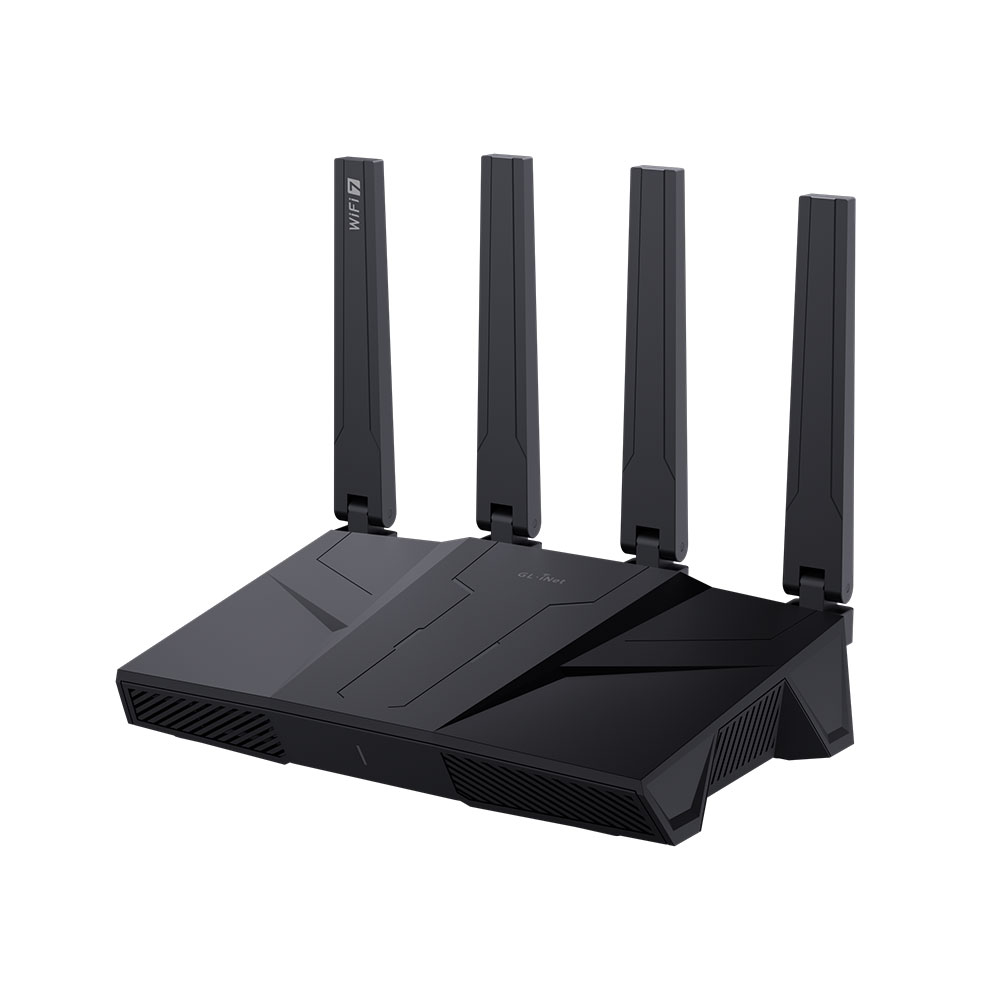
GL.iNet Flint 3 (BE9300) review
The Flint 3 is the home router successor to the Flint 2. Where the Flint 2 had Wi-Fi 6E, the Flint 3 has Wi-Fi 7 — the latest generation of Wi-Fi with lower latency and higher speeds. Add five 2.5G Ethernet ports, a Qualcomm chipset and full OpenWrt support.
Specifications
| Property | Value |
|---|---|
| Processor | Qualcomm quad-core 1.5 GHz |
| RAM | 1 GB DDR4 |
| Storage | 8 GB eMMC |
| Wi-Fi | Wi-Fi 7 tri-band (BE9300) |
| Wi-Fi speeds | 688 Mbps (2.4G) + 2,882 Mbps (5G) + 5,765 Mbps (6G) |
| Ethernet | 5x 2.5 Gbps (4 LAN + 1 WAN) |
| Operating System | OpenWrt |
| WireGuard | ~680 Mbps |
| OpenVPN-DCO | ~680 Mbps |
| Price | €179 – €229 |
Wi-Fi 7: what changes in practice?
Wi-Fi 7 brings three relevant improvements over Wi-Fi 6/6E:
Multi-Link Operation (MLO): A device can be simultaneously connected via 2.4, 5 and 6 GHz. The router automatically chooses the fastest band. Fewer handoffs when moving through your home.
4K-QAM: Higher modulation — more data per signal cycle under good conditions. Relevant at short distance from the router.
Lower latency: Better for gaming, video calls and real-time applications. Not relevant for VPN throughput, but noticeable in daily use.
Practical note: Wi-Fi 7 requires Wi-Fi 7 clients (newer laptops and phones). Older devices connect fine via Wi-Fi 6 or 5.
Five 2.5G ports: the difference
The Flint 2 had one 2.5G WAN port and four Gigabit LAN ports. The Flint 3 has five 2.5G ports — all of them. That means:
- Wired devices can reach up to 2.5 Gbps if your NAS, server or gaming PC supports it
- Backbone connection to a Wi-Fi access point or switch runs at 2.5G instead of 1G
- More flexibility for multi-WAN configurations
WireGuard: 680 Mbps
The Flint 3 achieves ~680 Mbps WireGuard. That is less than the Flint 2 (~850 Mbps) and the Brume 3 (~1,100 Mbps). The reason: the Qualcomm chipset is optimised for Wi-Fi throughput and port density, not purely for VPN processing.
For most users, 680 Mbps is more than enough — it is faster than most home internet connections. If WireGuard speed is your top priority, choose the Brume 3 as a gateway or the Flint 2.
Qualcomm vs MediaTek: does it matter?
The Flint 2 uses MediaTek (MT6000). The Flint 3 uses Qualcomm.
Qualcomm advantage: Historically better OpenWrt community support. Qualcomm chipsets are widely used in high-end routers and have mature driver support.
In practice: For normal use this is not noticeable. For those who go deep into OpenWrt and want to run custom software: Qualcomm hardware has more available packages and better community documentation.
Built-in features
Via the GL.iNet web interface:
- WireGuard and OpenVPN client
- DNS-over-TLS and DNS-over-HTTPS
- AdGuard Home
- VPN policy per device and per domain
- Guest network with client isolation
- Kill switch
- Multi-WAN failover
Flint 2 or Flint 3?
| Flint 2 (MT6000) | Flint 3 (BE9300) | |
|---|---|---|
| Wi-Fi | Wi-Fi 6E | Wi-Fi 7 |
| Ethernet | 1x 2.5G WAN + 4x GbE LAN | 5x 2.5G |
| WireGuard | ~850 Mbps | ~680 Mbps |
| Chipset | MediaTek | Qualcomm |
| Price | ~€139 | €179–229 |
Choose Flint 2 if: You want higher WireGuard speed at a lower price and Wi-Fi 6E is sufficient.
Choose Flint 3 if: You want Wi-Fi 7, you have multiple 2.5G wired devices, or you prefer Qualcomm hardware.
Conclusion
The Flint 3 is a strong home router for those who want Wi-Fi 7 now and need multiple fast wired connections. Five 2.5G ports are rare at this price point. The lower WireGuard figure compared to the Flint 2 is a mild disappointment but rarely a practical issue.
See also:
- GL.iNet Flint 2 review — previous generation, slightly more WireGuard speed
- GL.iNet Brume 3 review — if you don’t need Wi-Fi but want maximum VPN speed
- GL.iNet travel router setup guide — configuring VPN, DNS and AdGuard Home