Camera glasses and privacy: what Meta's AI glasses record, and what you can do
Camera glasses such as Meta's Ray-Ban and Oakley models have a camera, microphones and an AI assistant in a frame that looks like ordinary glasses. This guide explains what they record, what reaches Meta, and what you can do, whether you wear them or are being filmed.
Camera glasses and privacy
Camera glasses such as Meta’s Ray-Ban and Oakley models have a camera, microphones and an AI assistant in a frame that looks like ordinary glasses. This guide explains what they record, what reaches Meta, and what you can do, whether you wear them or are being filmed.
Who this guide is for
- People who might be filmed (everyone, in practice): how to recognise these glasses, what the recording light does and doesn’t tell you, and what you can do about it.
- People who wear them or are thinking of buying a pair: what Meta gets from you and the people around you, which settings to change, and what you’re allowed to film and share.
- Shops, clubs, schools, care homes and employers deciding whether to allow them.
The legal part is about the Netherlands and the EU, and says so. The practical parts apply anywhere.
What this guide does not solve
It can’t tell you whether a specific recording of you was legal; that depends on where, how and what happened to the footage, and a lawyer or the police can judge that better. It doesn’t cover smart glasses without a camera (display-only glasses), which don’t raise the recording problem.
What these glasses are
Meta’s AI glasses, made with EssilorLuxottica under the Ray-Ban and Oakley brands, look like normal glasses or sunglasses and are available with prescription lenses. They take photos and video, record sound, play music, make calls and answer questions through Meta AI, which can also “look” through the camera. In the Netherlands they’re sold by mainstream opticians such as Pearle, Hans Anders and GrandOptical, for roughly €419 to €500, and EssilorLuxottica reported more than 7 million Ray-Ban and Oakley AI glasses sold in 2025 (Consumentenbond, August 2026). Meta is the biggest maker; Google and others have announced their own.
The difference from a phone is visibility. When someone films you with a phone, you see the phone. With glasses, the only sign is a small light, which the Dutch government itself says many people don’t recognise (answers to parliamentary questions, 24 September 2026).
If you might be filmed
How to recognise camera glasses
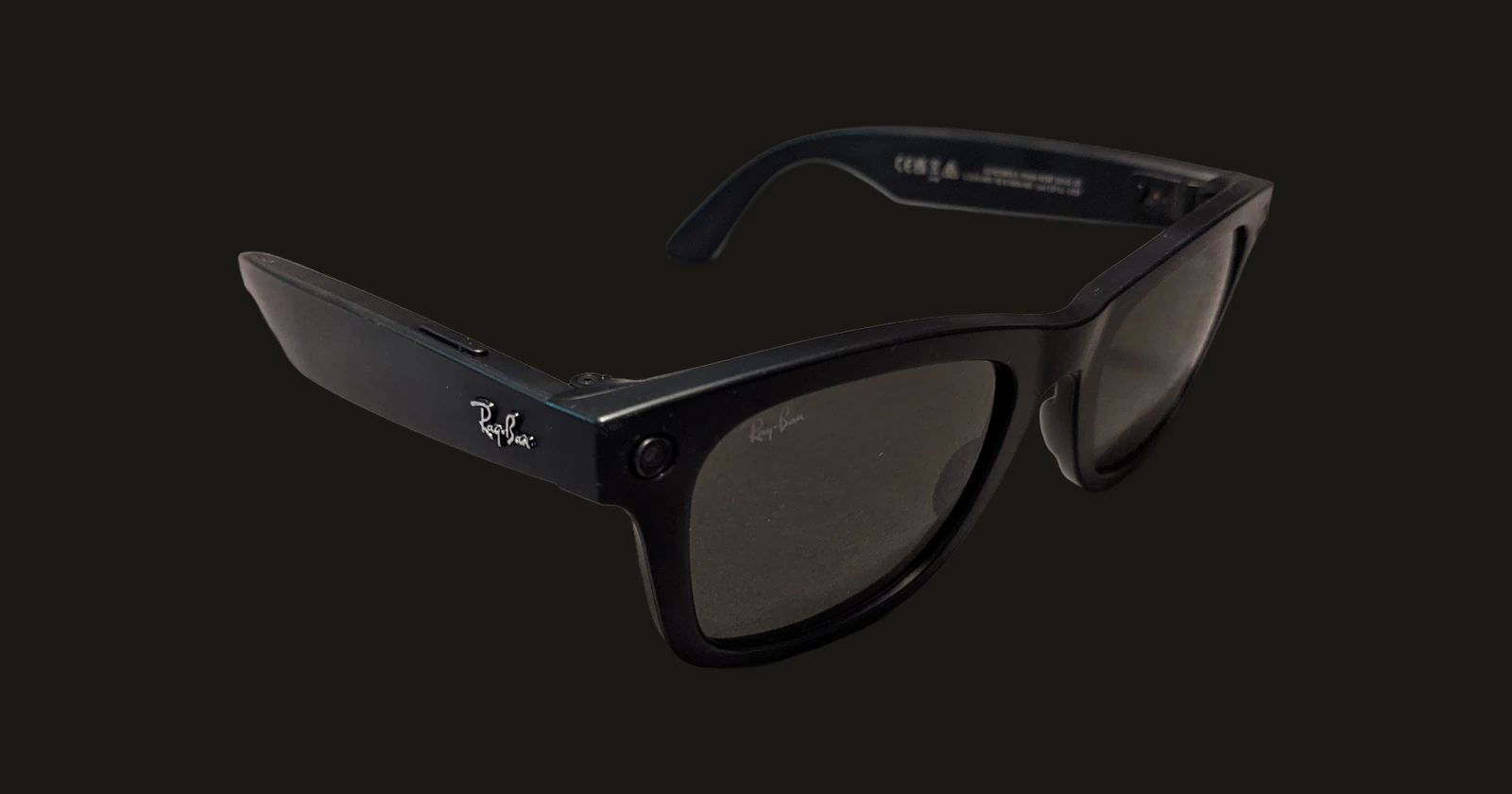
- a small lens in the front of the frame, usually at a corner by the hinge
- thicker temples (the arms) than ordinary glasses, because the electronics sit there
- a small light next to the lens
Many models are hard to tell from normal glasses, especially sunglasses.
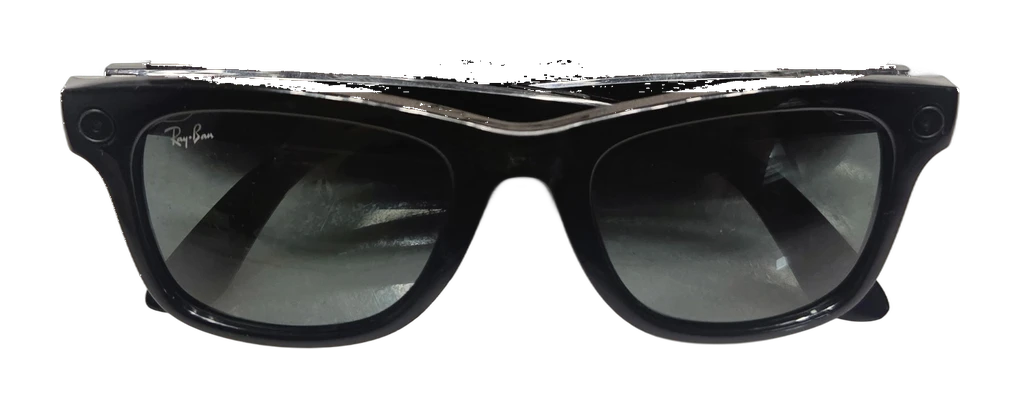
Ray-Ban Meta (first generation): the two small circles at the top corners of the frame are the camera and the recording light. The cover photo above shows the older Ray-Ban Stories from the side, with the lens next to the hinge and the thicker temples. Photos: CCadio (CC BY 4.0) and cavebear42 (CC BY-SA 4.0), Wikimedia Commons.
What the light does, and doesn’t, tell you
According to Meta, a white light on the front blinks briefly for a photo and stays lit during video (its help center says it stays on, its privacy page that it keeps blinking), has no off switch, and the camera is disabled when the light is covered. In July 2026 Meta said it was updating the glasses so the camera also switches off if the light has been physically tampered with or destroyed (Meta, July 2026); its privacy page now says the camera is disabled whenever the glasses detect that the light was covered, tampered with or destroyed, and that the wearer is told to uncover it first. Meta describes the light as showing when content is captured “for your gallery”.
Its limits are real:
- Workarounds exist. Stickers, modifications and even paid services to cover or get around the light are offered online, the Dutch government notes; Meta says it removes ads for such tampering services and takes legal action against sellers, and its July update targets lights that were modified or destroyed. The Consumentenbond reports that small stickers with a cut-out still let the glasses’ sensor see enough light while people around barely see it.
- It’s easy to miss. The Dutch government notes it can be missed in busy or bright places, by people with a visual impairment or colour blindness, and from an angle.
- First-generation Meta glasses don’t switch the camera off when the light is covered, going by Meta’s own description (that started with the second generation), and other brands may have no such protection at all.
So a light you see means you are probably being recorded; no light you see means very little.
Your rights in the Netherlands
The government’s answers of 24 September 2026 list the rules that apply. In short:
- Covert filming can be a crime. Under the Dutch Criminal Code, making an image of someone in a home or another place not open to the public, with a device whose presence isn’t clearly made known, is punishable with up to a year in prison (art. 139f). In public places there’s a lesser offence for covert recording with a device installed for that purpose (art. 441b); whether glasses count as that is not settled. Secretly recording a conversation you’re not part of is also punishable (art. 139a–b). Filming in toilets and changing rooms is the clear case.
- Publishing is a separate question. Portrait right (Auteurswet art. 21) is about publishing, not making, an image: you can object to a recognisable image of you being published if you have a “reasonable interest”.
- Privacy law (the AVG/GDPR) applies once filming goes beyond purely personal use, such as a vlog, a channel or footage of strangers in public. Purely personal footage, like a family birthday, falls outside it, as long as you keep it to yourself or share it in a very small circle, such as a small family group chat; posting it on social media brings it back under the law (Autoriteit Persoonsgegevens, in Dutch).
- The regulator reads it strictly. The AP says that outside your own home you usually may not record with camera glasses, and that the recording light is not enough: you have to tell people you want to film them and give them the chance to stay out of frame.
- If you suffer harm, filming without consent can be an unlawful act under civil law (art. 6:162 BW).
What you can do
- Ask. If you see someone wearing camera glasses, you can ask whether they’re recording and ask them to stop and delete what they took.
- In a shop, club, venue or workplace: tell staff or security. Many places can and do ban camera glasses through house rules.
- If footage of you appears online: ask the person who posted it, in writing, to remove it, then report it to the platform. If it’s footage of a sexual nature, report it to the police: making or publishing such footage of someone without consent is a crime in itself (Criminal Code art. 254ba).
- Complain or report: you can complain to the Autoriteit Persoonsgegevens (AP) or file a report with the police. By September 2026 the AP had received six signals and one complaint about camera glasses, so reports are still rare.
If you wear them, or are thinking of buying a pair
What reaches Meta
- Photos and videos are stored on the glasses first, and you choose when to import them, according to Meta. But the Meta AI app, which you need to set up the glasses, imports media to your phone automatically: Meta says auto-import is on by default on iPhones and on Android 13 and later (Meta help). And the AI features don’t run on the glasses: when you ask Meta AI about what you see, the image goes to Meta (EFF, March 2026).
- Your voice. Meta’s voice privacy notice as published in the Netherlands (in force since 22 July 2025) presents storing your voice recordings as your choice: with storage off, recordings are deleted right after processing and not used to improve Meta’s products; with it on, trained human reviewers may listen, and recordings are kept for up to a year. In the US, Meta told owners in April 2025 that recordings would be stored with no option to opt out, only to delete them afterwards (TechCrunch). Meta’s notice for the US (same date; we read it from a US connection on 31 October 2026, and the Australian version says the same) still says recordings from the Meta AI glasses are stored by default, kept for up to a year and reviewed by trained reviewers; you can delete them sooner in the app, and accidental activations Meta detects are deleted within 90 days. The off switch it mentions is for the older Ray-Ban Stories only (Meta, US; Australia). Whether you can turn storage off depends on your region, so check the settings.
- Human review. Swedish journalists found that workers reviewing footage from Meta glasses saw nudity, sex and people on the toilet (EFF); according to the Consumentenbond, they worked for a company in Kenya and the footage also showed bank cards. Meta told the BBC this is covered by its AI terms. Meta ended that contract in April 2026, saying the company didn’t meet its standards; the company, Sama, said it was surprised and hadn’t been told of any shortfalls (The Next Web; we haven’t read Meta’s own statement).
- The people around you. Whether images and sound of bystanders end up training AI “cannot be ruled out”, the Dutch government says; it’s only allowed with a legal basis under the GDPR, and the regulators judge that. The government also says responsibility for bystanders’ data often lies with both the wearer and Meta.
Settings worth changing
Most of these are in one place in the Meta AI app, according to Meta’s help center (November 2026): tap Glasses (top right) → Device settings → under Glasses, tap your glasses → scroll down and tap Glasses privacy. If you have more than one device paired, swipe to the right one before you tap Device settings.
- Cloud media: off. In Glasses privacy, the Cloud media switch. With it on, photos and videos go to Meta’s cloud for processing and are kept there for 30 days; Meta says some features need it, such as sending a photo by voice (“Hey Meta, send a photo”) (Meta help). The EFF names this as the most important setting.
- Additional data: off. Also in Glasses privacy. This is data about how you use the glasses (which features, how often, how well they work). Meta says the choice applies to every device paired with the app and doesn’t cover your photos and videos; data Meta calls essential is always used (Meta help).
- Voice recordings: storage off where your region offers it, then delete what’s stored. Meta’s voice notice for the Netherlands says you can choose whether recordings are stored and turn that off in the settings; Meta’s help center doesn’t say where that switch is (as of November 2026). Outside the EU, Meta’s notice says recordings are stored by default (see above). Stored recordings are listed under Glasses privacy → Voice activity log, and Meta says you can delete them in the app (Meta help).
- Auto-import: decide. This one isn’t under Glasses privacy: in the same glasses settings, tap Media → Auto-import media. Meta says it’s on by default on iPhones and Android 13 and later. It moves photos and videos to your phone’s photo app, and from there your phone’s cloud backup (Google Photos, iCloud) can pick them up. If you turn it off, you import by hand: in the app, tap Glasses, then Import next to Photos.
Already set up? Turning voice storage off doesn’t remove what’s already stored: Meta’s notice says earlier recordings stay for up to a year unless you delete them, so clear the Voice activity log as well. Media you’ve already imported is in your phone’s photo app and possibly its cloud backup; deleting it in the Meta AI app also deletes it from the phone’s photo app and from Meta’s cloud, according to Meta.
The labels follow Meta’s help center as read on 7 November 2026 (app version 297.1 on iPhone and Android); menus change with app updates and can differ by region.
What you can film, and share
- Footage for yourself, of your own life, is fine as long as you keep it to yourself or a very small circle. Strangers who are unrecognisable in the background of a holiday clip are not the problem.
- Don’t film in toilets, changing rooms, saunas, bedrooms or other private places. That’s where the criminal law applies most clearly. In public, the AP also names places where filming is sensitive, such as a beach or a demonstration.
- Ask people before you record them at a gathering or in conversation. Many people are less comfortable with glasses than with a phone, precisely because they can’t see what you’re doing.
- Don’t post recognisable strangers without their consent, and blur faces if you upload footage from public places.
- Respect house rules. Venues, shops and employers can ban the glasses; the AP has asked organisations to do so in sensitive places.
- Don’t make them your everyday glasses. The AP advises against using camera glasses as your regular or prescription pair, partly because it’s easy to forget they’re still recording; keep ordinary glasses to hand.
- Don’t use AI features on other people (“who is this?”, “describe this person”): that sends their image to Meta.
When they’re genuinely useful
For blind and low-vision users, the glasses can be a real accessibility tool: through Be My Eyes you can call a sighted volunteer by voice, who sees through the glasses’ camera and helps you read a label or find your way, with both hands free. Be My Eyes lists Australia, Canada, Ireland, the UK, the US, France, Denmark, Germany, India, Italy, Mexico, Spain and the UAE among the countries where it’s available on Meta’s glasses; the Netherlands is not on that list. This is a real benefit, and it comes with the same data trade-offs as above. If this is why you’re considering a pair, the settings section matters even more, and it’s worth telling people around you when you’re on a call.
For shops, clubs, schools, care homes and employers
You can set house rules that ban camera glasses, or ask visitors to take them off or put them away, the same way many places handle phone cameras. The AP called on organisations in September 2026 to do this especially in sensitive places such as hospitals, courts and places of worship (AP, 22 September 2026, in Dutch). It also calls on employers to ban them at work as far as possible, to protect business secrets and the privacy of staff and customers. TivoliVredenburg in Utrecht and several cruise lines already do. Make the rule visible at the entrance, and tell staff what to do when someone wears them.
Where this is going
- The Netherlands has no ban. The cabinet considers a ban a heavy measure and was waiting for the European Data Protection Board (EDPB), in which the AP takes part; that statement came on 13 October 2026 (next point); as of 31 October 2026 the cabinet hasn’t responded, and we’ll update this guide when it does. The AP has also started its own look at AI wearables and the companies that make them. A sales ban on stickers and other tools to hide the light would, in the cabinet’s view, be legally weak, easy to get around and hard to enforce.
- EU regulators have spoken, without a ban (13 October 2026). The EDPB, the body of Europe’s data protection authorities, adopted a first statement on smart glasses: preliminary guidance, not a new law. Wearers who film family or friends and share only with them stay outside the GDPR; posting to a public account, or using the glasses for work or political activity, makes the wearer responsible under it, and criminal law can apply either way. Meta and other makers stay responsible for their own processing, including AI features that analyse images with other people in them, and can’t hand that to wearers; the EDPB says valid consent from bystanders would be hard for them to get, and that using bystander data for AI training or other commercial purposes would be particularly hard to justify. It also says today’s recording indicators leave many bystanders unaware, and asks for signals that are hard to disable and easy to notice (a light visible in many lighting conditions, no recording when it’s covered, sounds, a recognisable design), storage switched off by default when the glasses are mainly used as an assistant, and blurring of bystanders, preferably on the device. The EDPB says it will keep working on the topic (EDPB statement; press release).
- Pressure for a ban is growing. A majority in the Tweede Kamer wants broader rules, and Bits of Freedom and the Consumentenbond both call for a ban. In September 2026 Bits of Freedom and programme maker Roel Maalderink made a satirical video filming Meta employees outside Meta’s Amsterdam office with the glasses; Meta removed it from Instagram for “bullying and harassment” (NOS; Bits of Freedom).
- Shops are pulling them. On 2 October 2026 optician chain Hans Anders stopped selling Meta’s glasses in the Netherlands and Belgium, and Wehkamp stopped too, both citing privacy risks. Hans Anders may sell them again once the political discussion is settled (ID.nl, based on ANP, in Dutch).
- Germany has a stricter law: it bans offering and owning telecoms equipment shaped like an everyday object that can secretly record conversations or images. Whether camera glasses fall under it is not settled, the Dutch government notes; the Netherlands has no such ban.
- Norway (not in the EU, but in the EEA, so the GDPR applies there too) plans a temporary ban. On 5 October 2026 its government announced it for places open to the public, such as parks, beaches, museums, shopping centres and events; places for children, such as schools, kindergartens and playgrounds; and privacy-sensitive places, such as health institutions and gyms with changing rooms. Private use stays allowed, vulnerable groups can get an exemption, and an expert group will advise on permanent rules (NTB via Framtida, in Norwegian; Reuters). It’s a proposal: the bill still has to go to the Norwegian parliament.
- France: the data protection authority CNIL called for vigilance in May 2026 rather than a ban, with advice for wearers (tell people nearby, switch capture off when you don’t need it), and is working on the glasses through the EDPB (CNIL, in French).
Recommendation by profile
| Profile | Practical route |
|---|---|
| Normal user | You don’t need to do anything special. Know what the glasses look like, and ask people to stop if they film you somewhere private. |
| Considering buying a pair | Decide what you want them for, change the settings above before first use, and treat the camera like a phone camera pointed at people: ask first. |
| Stalking or harassment | Covert footage can be evidence: note the time and place, report it to the police, and use your rights to have published footage removed. |
| Family and children | Talk with teenagers about being filmed without knowing, and about not filming others in changing rooms or at parties. |
| Small business | Decide on a house rule, especially if you run a gym, salon, practice or venue, and make it visible. |
Stopping point
For most readers it’s enough to recognise camera glasses, know that the light can’t be fully trusted, and know you can ask someone to stop and delete. If you wear them, change the privacy settings once and keep them off in private places.
Next step
Related guides
- Removing metadata from documents and photos — before you share any footage
- Using your GDPR rights — asking an organisation, including Meta, what it holds about you
Profiles
- Profile: stalking or harassment — when being filmed is part of a pattern
- Profile: family and children — talking about cameras with teenagers